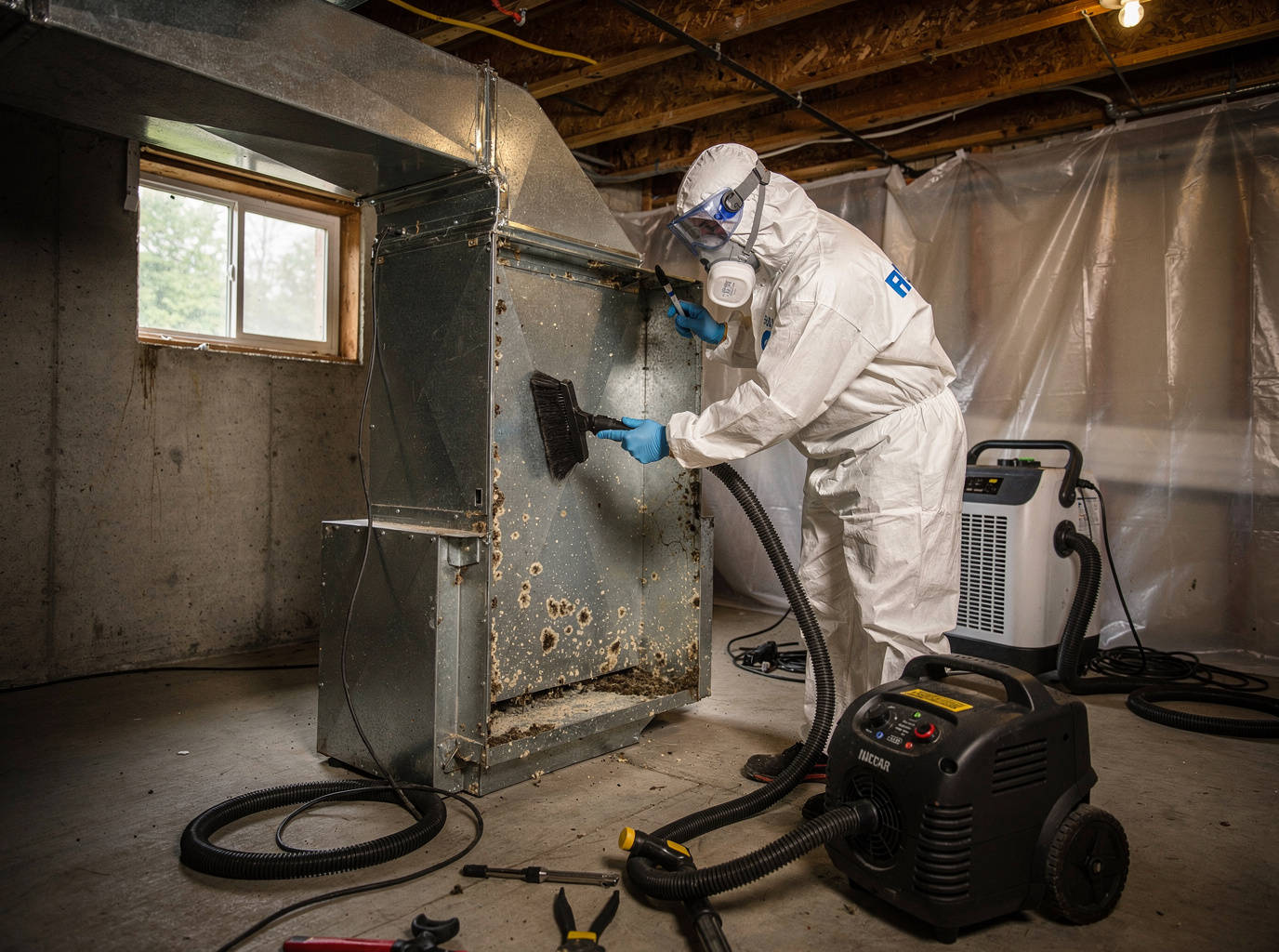
Royal Oak’s older housing stock along the Woodward Corridor and in Northwood often features attic and basement HVAC runs that sit against uninsulated walls. Cold winter air in Oakland County’s humid continental climate pulls moisture out of warmer duct air, creating condensation that feeds mold on fiberglass liners and coil fins. Technicians must pull registers, scope trunk lines with cameras, and treat both supply and return sides without disturbing original plaster or lathe in Downtown Royal Oak homes.
Ferndale and Madison Heights split-levels built in the 1950s–70s frequently have horizontal duct runs in crawl spaces that sit inches above damp soil. When spring thaw raises groundwater, spores travel through the system and settle on evaporator coils. Remediation requires negative-air machines at each register, antimicrobial fogging of lined ducts, and coil removal for off-site cleaning when fins are packed with organic debris.
Homeowners in Birmingham and Royal Oak commonly mistake musty odors for simple dust until the furnace kicks on in October. By then mold has already colonized the blower housing and secondary drain pans. Proper work includes sealing access panels with mastic after treatment, replacing porous insulation, and verifying static pressure remains within original equipment specs so the system does not short-cycle once restored.
Technician insight
In Royal Oak the thing that catches most people out with HVAC mold removal is the uninsulated ductwork running right against the attic deck in Northwood bungalows; once winter temperatures drop, that cold surface pulls moisture out of the air every time the furnace runs, and the mold keeps coming back until the insulation is replaced.
Woodward Corridor Split-Level
Homeowner noticed musty smell only when heat came on. Inspection found heavy growth on the attic trunk line where it touched the roof deck. Crew contained the system, removed contaminated liner, treated coils, and installed new closed-cell insulation. Odor disappeared and system airflow returned to normal.
HVAC Mold Removal Services We Offer
✓Ductwork Mold Remediation
Camera inspection and antimicrobial treatment of supply and return trunks in Royal Oak attics and crawl spaces to stop spores from recirculating through the home.
✓Evaporator Coil Cleaning
Removal and off-site washing of A-coils and blower wheels that have collected condensation and debris during Oakland County’s humid summers.
✓HVAC System Containment
Setup of negative-air machines and sealed barriers at every register to prevent cross-contamination while work occurs in occupied Northwood and Downtown homes.
✓Condensate Drain Line Treatment
Clearing and treating primary and secondary drains that back up in cold weather, a common trigger for pan mold in Ferndale and Madison Heights systems.
✓Attic Duct Insulation Replacement
Removal of contaminated fiberglass liner and installation of new closed-cell insulation on ducts running through unconditioned Royal Oak attics.
HVAC Mold Removal Cost in Royal Oak, MI
| Service | Typical Range | What Affects It |
|---|---|---|
| Initial HVAC Mold Inspection | $175–$325 | Includes camera scope and moisture mapping; higher in two-story homes with finished basements. |
| Ductwork Remediation | $850–$1,800 | Varies with linear footage and whether attic or crawl-space access requires temporary flooring. |
| Evaporator Coil Cleaning | $450–$750 | Includes removal and reinstall; higher when fins are heavily packed or coil must travel off-site. |
| Full System Containment | $300–$500 | Required for occupied homes; price rises with multiple returns or complex layouts. |
Ranges are typical for Royal Oak, MI and confirmed with an exact written quote before any work starts.
How it works
- 1
System Assessment
Technicians arrive during posted hours, inspect registers, coils and duct runs with borescopes, and map moisture readings in Royal Oak homes.
- 2
Containment Setup
Negative-air machines and plastic barriers isolate the HVAC system from living spaces to keep spores from migrating into finished areas.
- 3
Source Removal
Contaminated insulation, coil sections and drain pans are removed or treated on-site; porous materials are bagged for disposal.
- 4
Restoration and Verification
New insulation is installed, coils are reinstalled, and post-treatment air samples confirm clearance before the system is returned to service.
Pricing
Cost depends on number of stories, duct accessibility, and whether coils must be removed for off-site cleaning.