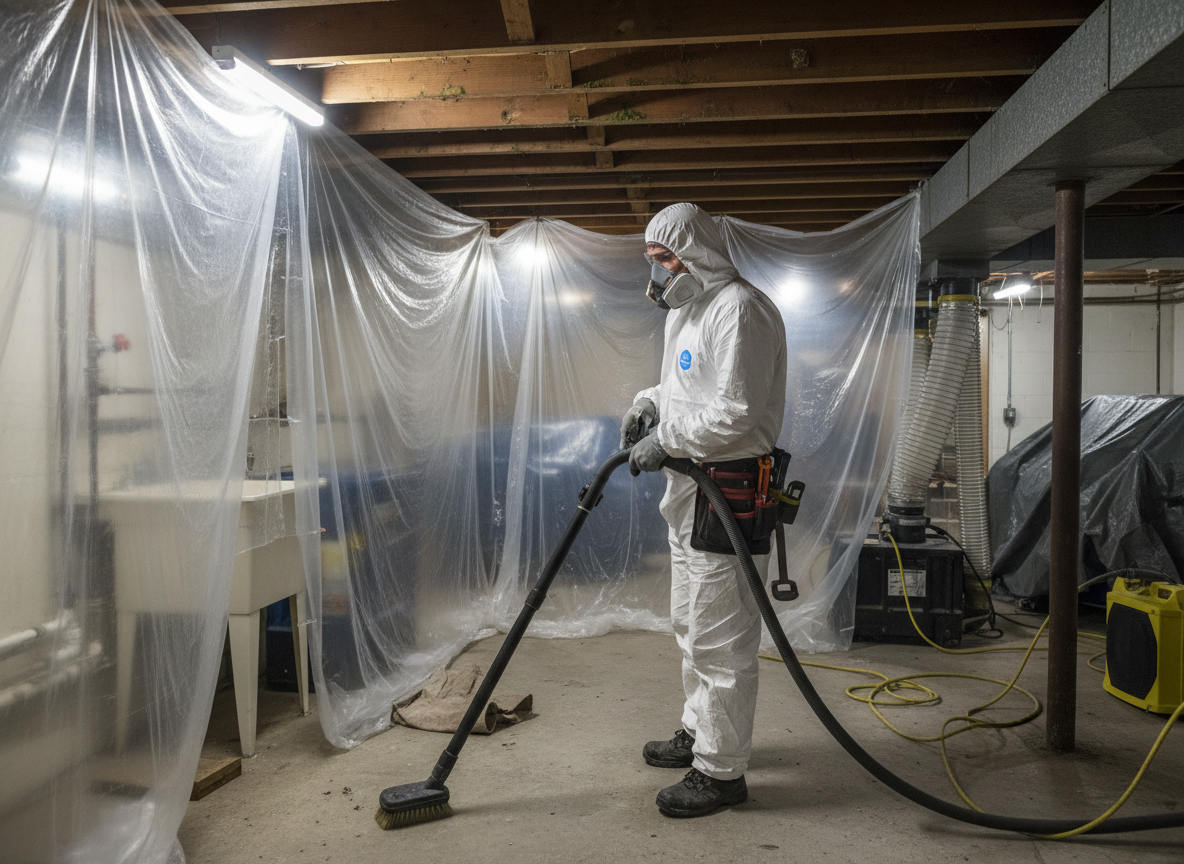
Royal Oak's pre-1960 housing stock along the Woodward Corridor and in Northwood often features uninsulated basements and attics that trap moisture when winter temperatures drop below freezing. Cold air holds less moisture, so indoor humidity spikes against cold surfaces, creating persistent condensation on ductwork and foundation walls. Crews must map these thermal bridges before any remediation because removing visible growth without addressing the hidden moisture plane leads to rapid regrowth within one heating season.
Ferndale and Madison Heights border properties frequently share sewer lines and grading issues that push water toward Royal Oak foundations during spring thaws. In these cases, mold extends behind plaster and into floor joists, requiring selective demolition rather than surface treatments. Technicians pull baseboards and test subfloor moisture content with pin meters to confirm the full extent before sealing the space, because incomplete removal in these tight older cavities allows spores to migrate through shared wall cavities into adjacent units.
Downtown Royal Oak commercial buildings near the Music Theatre and Memorial Park often have flat roofs and HVAC systems that cycle warm air against cold exterior walls. This pattern produces mold on insulation inside return ducts and around rooftop units. Remediation here includes negative-air machines exhausting through ground-floor windows to avoid re-entrainment into neighboring businesses, plus post-job verification with air sampling to satisfy Oakland County health requirements for occupied spaces.
Technician insight
In Royal Oak the thing that catches most people out with mold removal is assuming winter dryness solves the problem; once temperatures stay below freezing for weeks, the real issue becomes hidden condensation on cold pipes and ducts inside walls that never fully dry until spring, so the growth keeps returning until those thermal bridges are insulated.
Northwood Basement After Pipe Burst
A homeowner in Northwood noticed musty smell near the laundry area after a January freeze. Inspection found black growth on the back side of drywall and along floor joists where a slow leak had wicked into the plaster. Crews removed the lower three feet of drywall, treated the joists, and added insulation to the cold-water line before drying and rebuilding.
Mold Removal Services We Offer
✓Basement Mold Remediation
Removes growth from foundation walls and joists common in Northwood's older homes where winter condensation meets poor grading from nearby Birmingham properties.
✓Attic Mold Removal
Targets insulation and rafters in Royal Oak homes where roof leaks and inadequate ventilation combine during long cold periods.
✓Crawl Space Mold Treatment
Addresses soil moisture and vapor drive in Woodward Corridor houses where dirt floors allow constant humidity migration upward.
✓HVAC Mold Removal
Cleans coils and ductwork in downtown buildings near the Detroit Zoo where temperature swings create condensation inside metal runs.
✓Post-Flood Mold Cleanup
Handles water-damaged materials after heavy spring rains that overwhelm older storm sewers shared with Ferndale and Madison Heights.
Mold Removal Cost in Royal Oak, MI
| Service | Typical Range | What Affects It |
|---|---|---|
| Small visible patch under 10 sq ft | $450–$850 | Higher when growth extends behind baseboards in Northwood homes |
| Basement wall and joist section | $1,200–$2,400 | Increases with shared sewer grading issues near Ferndale |
| Attic insulation and rafter treatment | $900–$1,800 | Varies by roof pitch and ventilation access in older downtown buildings |
| HVAC duct and coil cleaning | $650–$1,100 | Higher for multi-story systems near Memorial Park commercial properties |
Ranges are typical for Royal Oak, MI and confirmed with an exact written quote before any work starts.
How it works
- 1
On-Site Assessment
Technician inspects all affected rooms, checks moisture levels in walls and floors, and identifies hidden growth behind finishes typical in Royal Oak's older stock.
- 2
Containment Setup
Plastic barriers and negative air machines isolate the work zone to prevent spore spread into living spaces or neighboring units along the Woodward Corridor.
- 3
Removal and Cleaning
Porous materials are removed, non-porous surfaces are treated with EPA-registered solutions, and HVAC components are cleaned where condensation has occurred.
- 4
Drying and Verification
Dehumidifiers and air movers dry the structure, followed by moisture meter checks and optional air sampling before barriers come down.
Pricing
Cost depends on square footage, hidden growth behind plaster, and access in tight Royal Oak basements and attics; quotes provided after inspection.